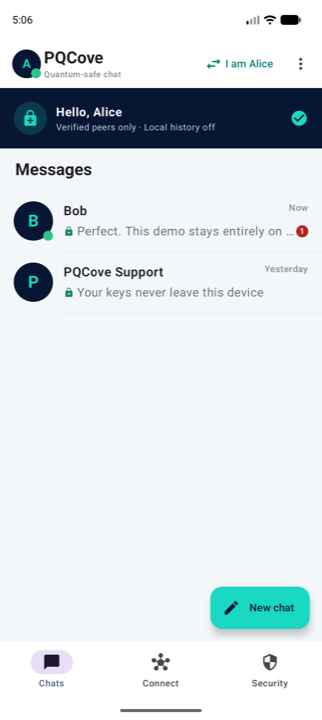
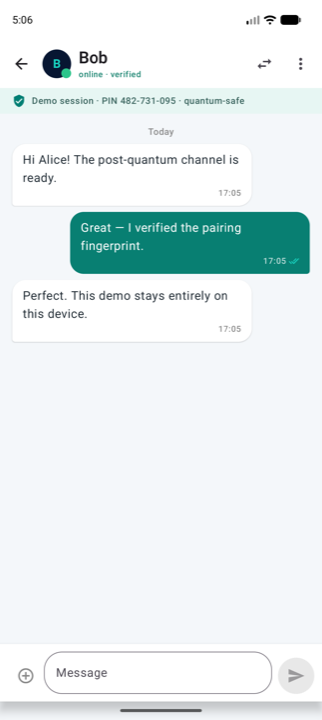
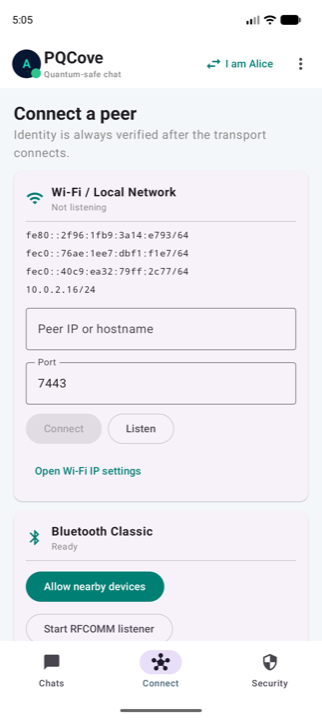
PQ PQCove Chat

Private chat for the post-quantum era

PQCove Chat

A Python CLI peer-to-peer messenger where every node listens, connects, and exchanges encrypted messages with a hybrid X25519 and ML-KEM session handshake.

Version 0.1.0 Protocol pqcove/1.0 License QGPL v3.0 Author dr. Šarūnas Grigaliūnas

Download

The archive contains the installable Python package, source code, tests, license, and README for PQCove Chat.

PQCove Chat 0.1.0

Verify the archive before installing. The checksum below is SHA-256 for pqcove-chat-0.1.0.zip.

SHA-256 47bf3d6b5e2f08bd8583861f8c691bea6989391e4674fcec5e32643eb3d38103

QGPL License

PQCove Chat is released under the Quantum General Public License (QGPL) v3.0 — Quantum-Safe Edition.

Quantum General Public License

The application archive includes the full QGPL text as LICENSE. The canonical license source is qgpl.org.

License QGPL-3.0 Quantum-safe copyleft for observation outputs and related materials, with distribution metadata requirements.

Install

PQCove Chat needs Python 3.11 or newer. Use --insecure-dev-mode only for local demos when liboqs is not installed.

Windows

Expand-Archive .\pqcove-chat-0.1.0.zip -DestinationPath .\pqcove-chat-0.1.0
cd .\pqcove-chat-0.1.0\pqcove-chat-0.1.0

py -3.11 -m venv .venv
.\.venv\Scripts\Activate.ps1
python -m pip install --upgrade pip
python -m pip install .

pqcove --help

Linux

unzip pqcove-chat-0.1.0.zip
cd pqcove-chat-0.1.0

python3.11 -m venv .venv
source .venv/bin/activate
python -m pip install --upgrade pip
python -m pip install .

pqcove --help

macOS

unzip pqcove-chat-0.1.0.zip
cd pqcove-chat-0.1.0

python3.11 -m venv .venv
source .venv/bin/activate
python -m pip install --upgrade pip
python -m pip install .

pqcove --help

Security Model

PQCove Chat is a research prototype, not an independently audited cryptographic product.

Hybrid Handshake

X25519 and ML-KEM-768 combine into directional AES-256-GCM session keys.

Peer Verification

Each session derives a matching 9-digit pairing PIN: XXX-XXX-XXX.

Local Storage

Private keys are encrypted at rest with passphrase-based scrypt and AES-GCM.

Open Prototype

The zip includes source and tests so the protocol path can be inspected locally.